Climbing Murcia
Welcome to the climbing community! If you are a beginner or want to resume climbing, in ClimbingMurcia we want to offer you an introduction to climbing and all its variations. We hope this serves you and look forward to see you out there in the wild.
Climbing Disciplines
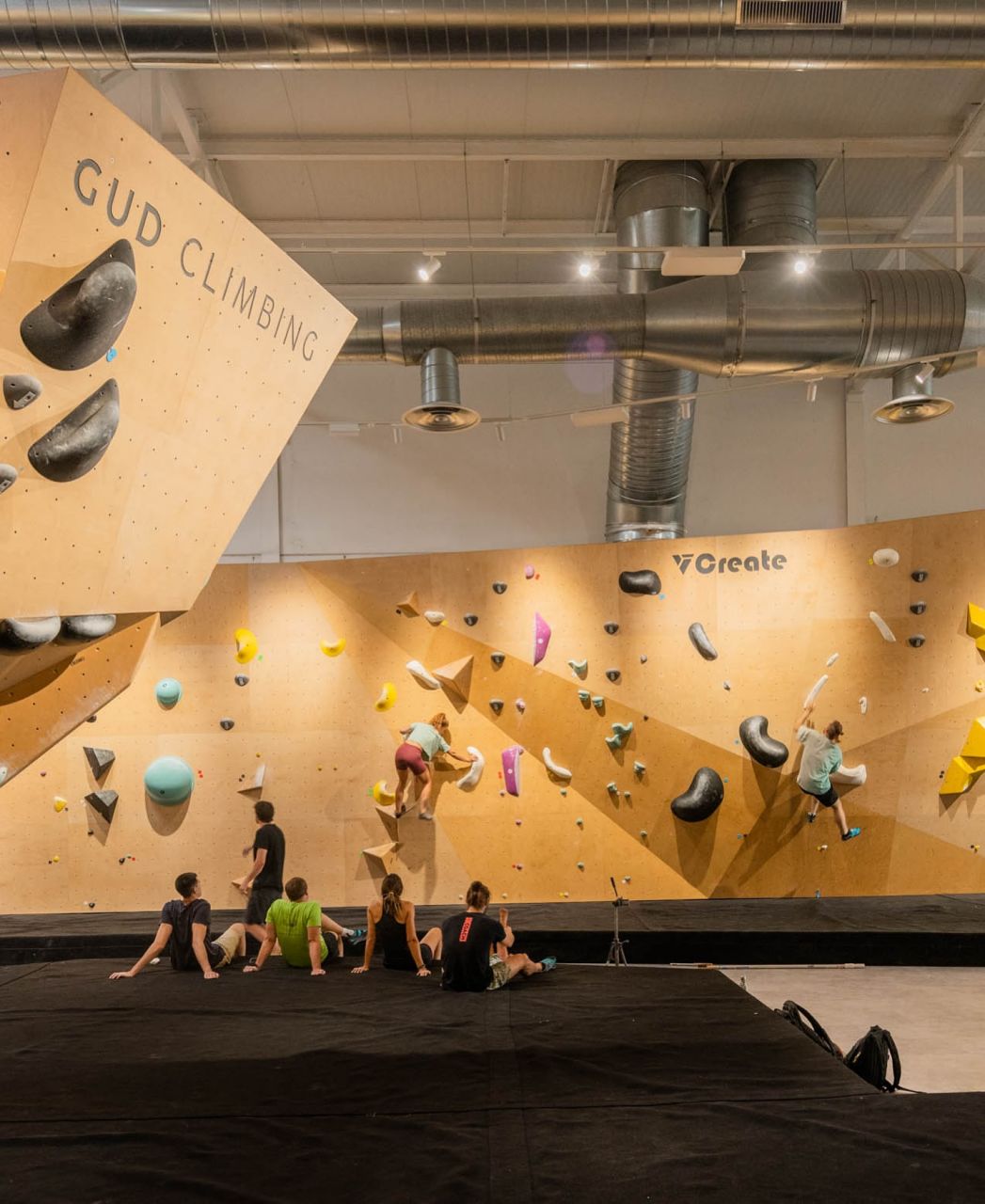
Indoor or gym climbing is relatively new and was initially developed as a way to train for rock climbing. That said, today more people climb indoors than on rock, and it is the most common way to get started in climbing. Many people choose this option because it offers a safe environment, easy year-round access, and fewer equipment requirements compared to rock climbing. The number of climbing gyms is growing rapidly; between 2007 and 2012 there was an estimated increase of 50%. Countries such as the United States, Germany, and Japan have hundreds of large climbing gyms, so it is very likely that you will find one in your area.
Generally speaking, two main disciplines are practiced in climbing gyms: bouldering and sport climbing. Some gyms offer only one, others both. There are additional disciplines practiced indoors, such as speed climbing, which we do not cover here.
Bouldering
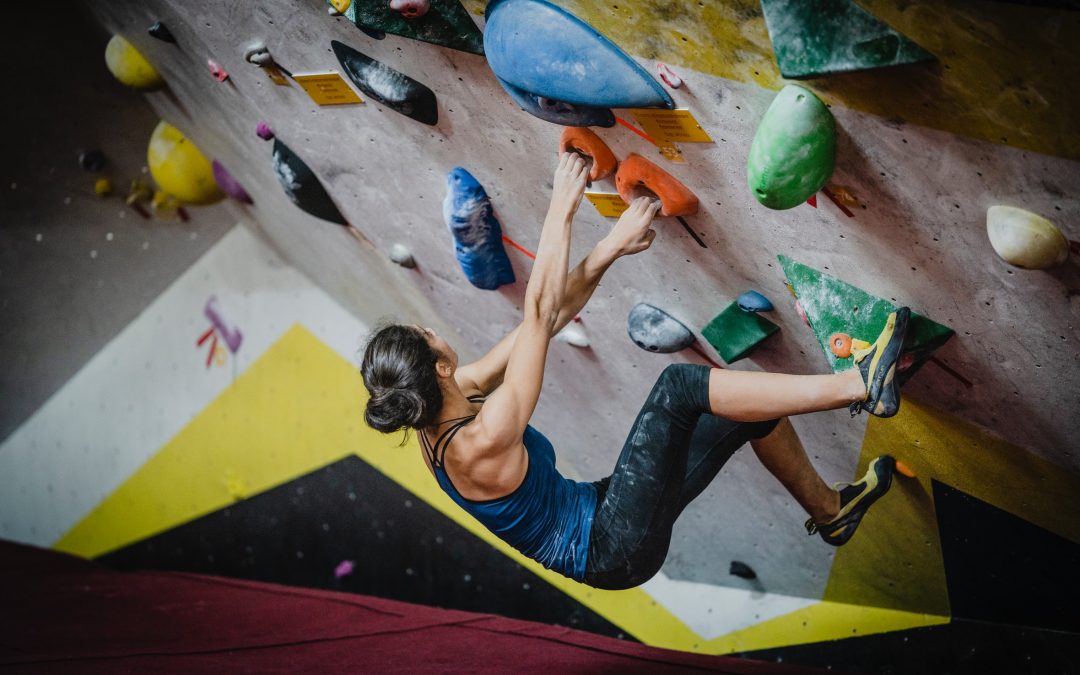
Bouldering, or block climbing, consists of climbing without a rope at heights that generally allow a safe jump to the ground. In bouldering gyms (or bouldering areas within a gym), the area beneath the walls is protected with padded mats to ensure a soft landing. Indoor bouldering is very popular because it has several obvious advantages. You do not need a partner and can go alone whenever you have time (although it is more fun to go with others, and you will likely meet like-minded people at the gym). You only need climbing shoes (which you can usually rent) and nothing else (perhaps a chalk bag). Since you do not usually climb to great heights, it is also more accessible for people with a fear of heights.
From a climbing perspective, bouldering allows you to focus entirely on the climbing and the movements, without worrying about belaying, rope handling, and similar tasks. It generally allows for faster progression and helps you climb harder grades in other disciplines. It is also an excellent complement to sport climbing, as it lets you focus on technical and physical weaknesses and train them specifically.
Sport Climbing (Indoor)
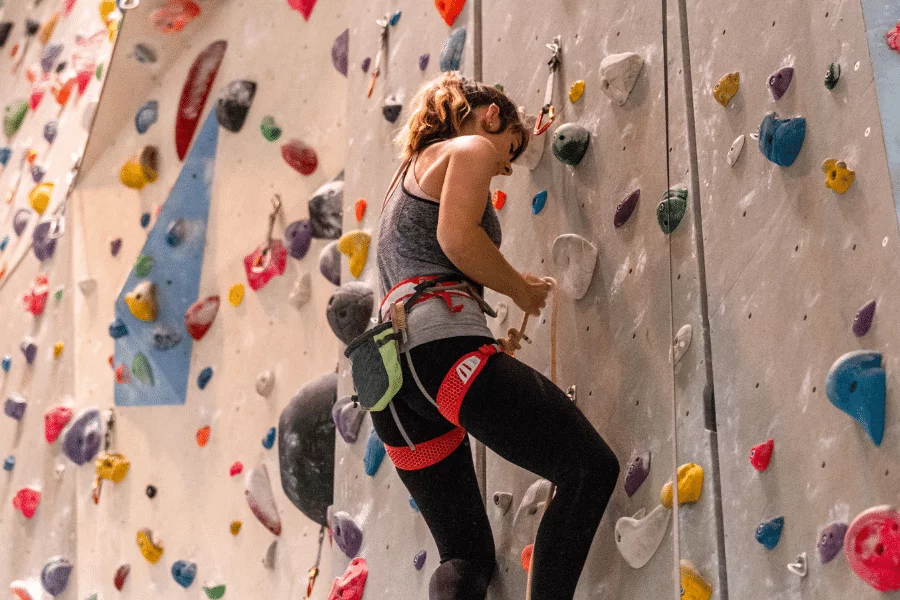
Many people refer to sport climbing when they talk about climbing in general. Indoor sport climbing means climbing routes with a rope, either lead climbing (meaning you clip the rope into fixed quickdraws as you climb higher) or top-rope climbing (you climb protected by a pre-installed rope). Depending on the gym, you will find routes with pre-installed ropes for top-roping and/or routes intended for lead climbing. Naturally, you can always install a rope yourself (or ask someone to do it) and top-rope a route that is designed for lead climbing.
The height (or length) of sport climbing routes in a gym obviously depends on the height of the facility, but they typically range from 10 to 30 meters and include slab routes (positive angle, less than vertical) as well as overhanging routes (negative angle, steeper than vertical).
Indoor sport climbing requires a partner you can trust to belay you (and prevent you from falling to the ground) and more equipment than bouldering. You need climbing shoes, a harness, a belay device, and—if you want to lead climb—a rope, although most gyms offer rental equipment. Check with your local gym to see if they offer beginner courses, or find a reliable and experienced partner to start practicing sport climbing.
Rock Climbing
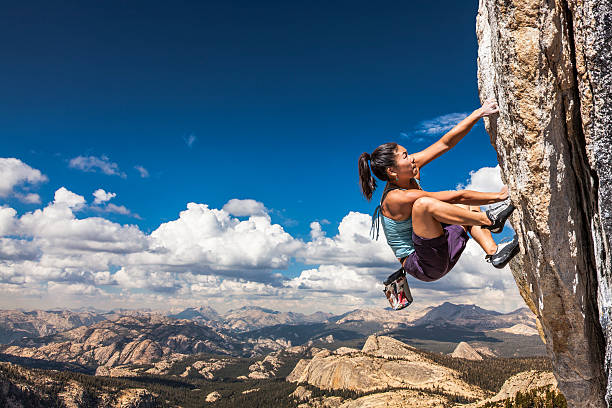
It is in nature that sport climbing has its roots, and enjoying the outdoors is one of the many reasons people love this sport. Fewer people begin their climbing journey on rock compared to a gym, but there is no reason not to start outdoors. Find a climbing or alpine school and see whether they offer beginner courses or introductory sessions. It will surely be an exciting and fun experience!
Rock climbing is divided into more disciplines than indoor climbing, although some overlap. Here we distinguish between three main outdoor climbing disciplines, but remember that there are others, such as psicobloc (deep water solo, DWS), ice climbing, aid climbing, or free soloing:
- Bouldering
- Sport climbing
- Traditional climbing
Bouldering (Outdoor)
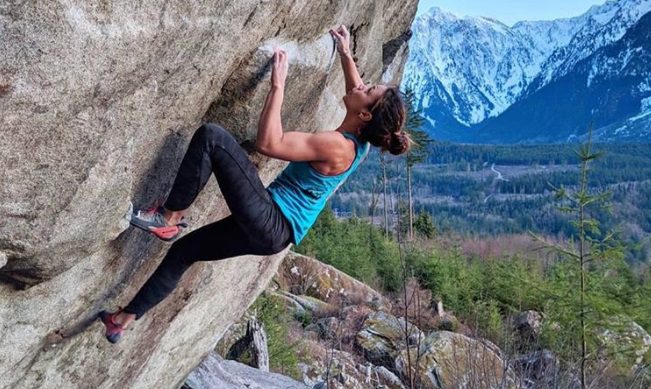
As explained in the indoor climbing section, bouldering is climbing without a rope at heights that generally allow a safe jump to the ground. Obviously, outdoor bouldering requires ensuring that the landing area is safe. Typically, padded mats called crash pads are placed on the ground so that, in case of a fall, the landing is safe. When bouldering outdoors, it is highly recommended to have one or more spotters, meaning someone who guides your fall toward the crash pad. Contrary to what many people think, the spotter’s job is not to stop your fall, but to ensure a safe and controlled landing. Bouldering does not require large walls or endless fields of blocks—you can have a great time even in a small backyard setting.
Sport Climbing(outdoor)
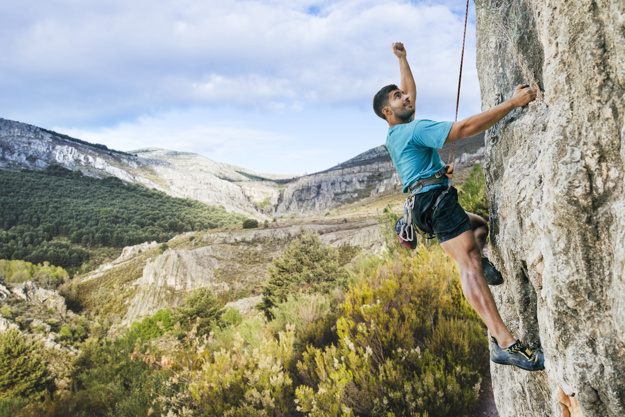
Sport climbing involves climbing routes equipped with pre-installed protection such as bolts or anchors. Routes can be single-pitch (the height allows you to climb to the top and lower back to the ground, with the belayer remaining on the ground) or multi-pitch (once the lead climber reaches the top of a pitch, the second climber climbs up to that point, from where the next pitch begins, and so on, allowing long routes to be climbed).
Outdoor sport climbing requires a reliable and experienced partner and, at a minimum, climbing shoes, a harness, a belay device, a rope, and several quickdraws to clip into the pre-installed anchors. The use of a helmet is also recommended.
Most sport climbing areas—if not all—have been developed by enthusiasts who have invested their free time and money to establish access to the cliffs, equip the routes (drilling and installing protection), and, ideally, maintain the quality and safety of the protection over time. Information about climbing areas and routes can usually be found in printed guidebooks and, of course, on ClimbingMurcia.
Traditional Climbing
Traditional or “trad” climbing involves climbing routes that the climber must protect by placing their own equipment as they ascend. In some cases, trad routes have fixed anchors that can be used to descend, or even pre-installed bolts, in which case they are considered mixed routes. As in sport climbing, routes can be single-pitch or multi-pitch. Traditional climbing requires the same basic equipment as sport climbing, plus removable protection gear. The most common pieces are nuts and cams (available in many different sizes), although many other types exist. Traditional climbing requires more experience than sport climbing, as protection must be placed while climbing.
Climbing Difficulty
It will not take long before you find yourself involved in a discussion about the difficulty of a route—whether in the gym or on rock, bouldering or sport climbing. Although most people climb for fun, it seems to be human nature to measure and compare progress using some form of grading system. In the diverse world of climbing, route difficulty is expressed using grading systems. As you might expect, there are many different grading systems, some specific to certain disciplines and others region-based (for example, grading systems vary by country). ClimbingMurcia is compatible with the French grading system.
The basic principle of all grading systems is that the harder the route, the higher the number and letter. This means that, in the French scale, a 6a route is harder than a 5b and, of course, a 6c is harder than a 6a.
Route difficulty is determined by many factors such as wall angle, size and quality of holds, distance between holds, difficulty of the movements required to reach the next hold, and whether the difficulty is sustained throughout the route. Naturally, grades have a subjective component, and what feels hard to one person may not feel as hard to another.
“Climbers are like small children who still retain their evolutionary roots.”
— Jeff Elison
Climbing Equipment
The first time you enter a climbing gear shop, you may feel overwhelmed by the sheer amount and variety of equipment (often simply called “gear”). In this chapter we briefly describe the most important equipment you will need when starting out. Over time, you will discover what else you need depending on the disciplines you prefer, the gear your climbing partners already own, and your personal preferences.
Climbing Shoes
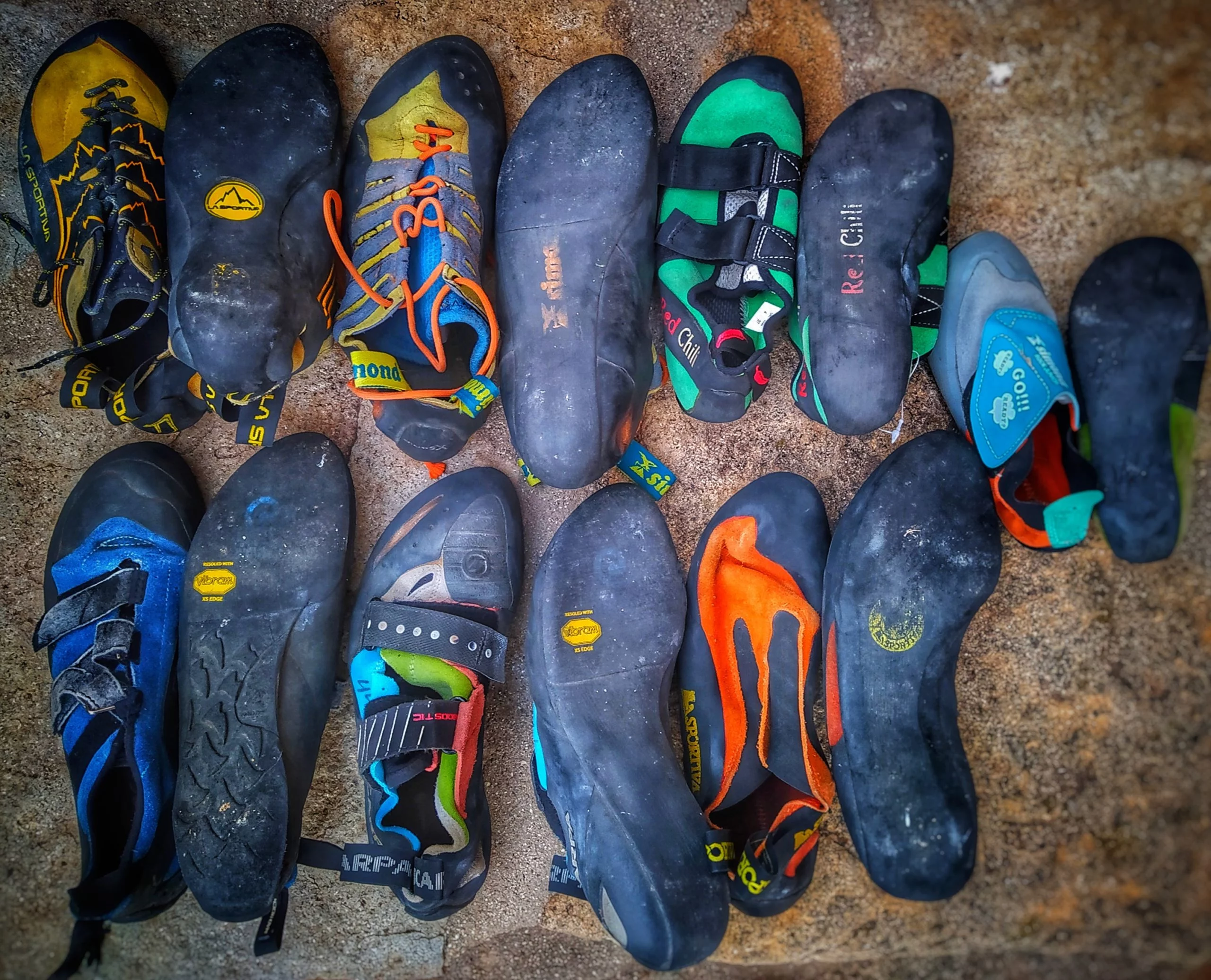
Climbing shoes will most likely be the first item you buy when you start climbing. Putting bare feet into rented shoes is not everyone’s favorite experience. The range of climbing shoes is vast, with many brands offering numerous models designed for different climbing styles and foot shapes. Another eternal debate concerns sizing. Generally, your climbing shoe size will be smaller than your street shoe size, allowing you to feel footholds better. Foot discomfort is common, and getting used to this type of footwear takes time.
For beginners, we recommend snug but comfortable climbing shoes. At first, you will not be climbing at the technical limit of a perfectly fitted shoe, and it is more important to enjoy climbing without pain than to stand on tiny footholds. Over time, you will identify the brand and model that best fit your foot, and you may end up owning several pairs—for example, one for long multi-pitch routes and another for bouldering or technical routes. Initially, it is best to visit a climbing shop with a small “try-on area” to find the model and size that suit you.
Harnesses
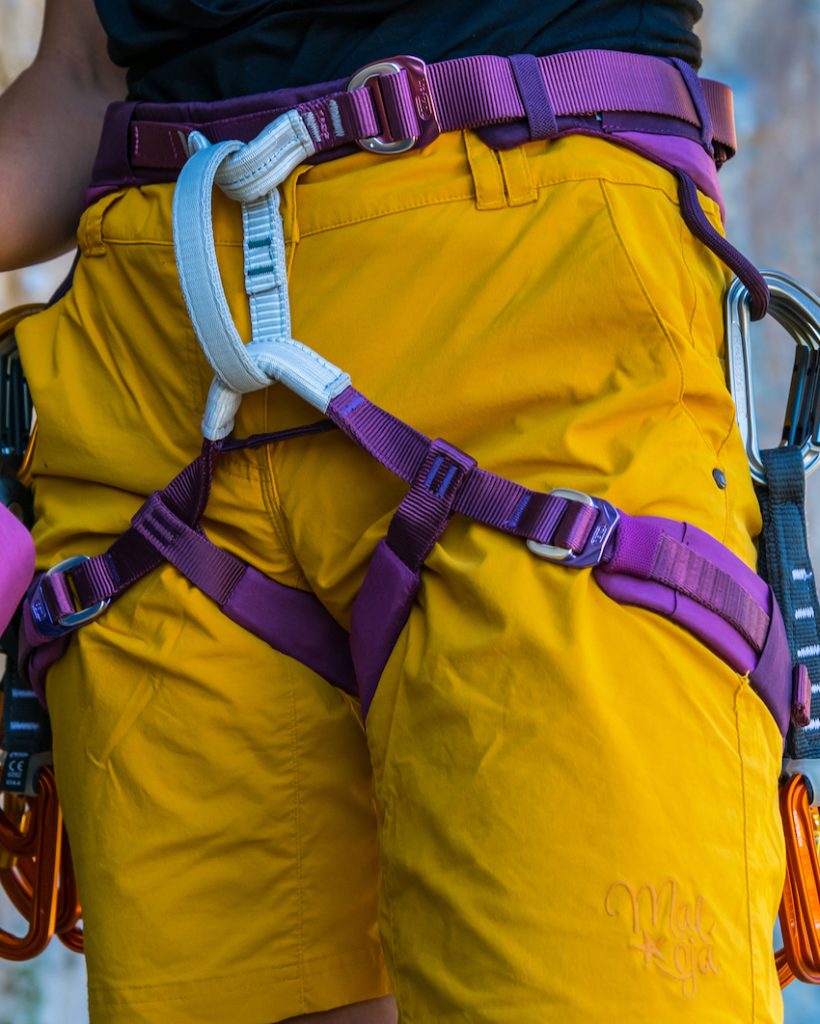
If you plan to practice sport or traditional climbing, you will soon need a harness. As with climbing shoes, the selection is very wide and depends somewhat on your plans. As a beginner, you do not need the lightest harness on the market. It is best to choose a comfortable one that allows you to belay or hang for long periods without feeling that it cuts into your thighs or hips. Another factor to consider is whether you want adjustable leg loops. Their advantage is that they can be adjusted depending on the clothing you are wearing (or if you want to lend the harness to a friend).
Chalk and Chalk Bags
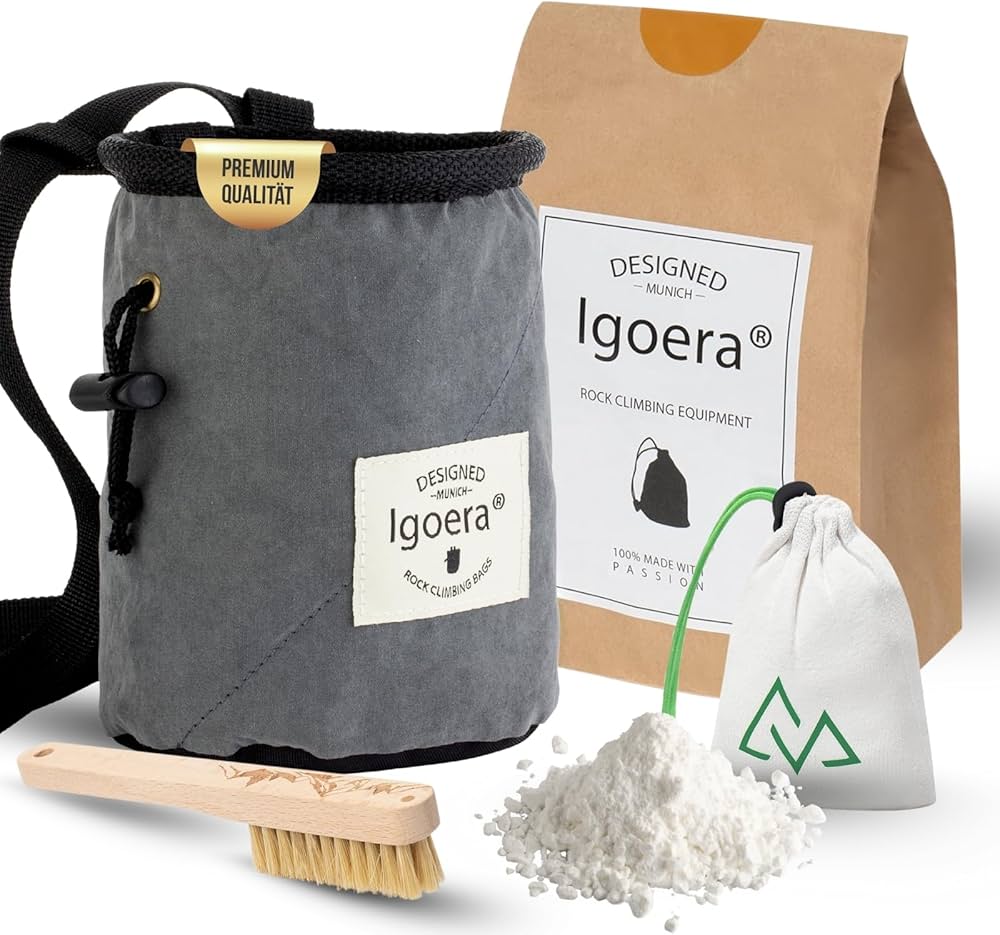
Chalk (fine magnesium carbonate powder) is used as a drying agent to reduce hand sweat in nearly all climbing disciplines. It is usually purchased in plastic bags and placed inside a chalk bag. Chalk bags are worn around the waist (or clipped to the harness) in sport or traditional climbing, or left on the ground when bouldering. Some gyms do not allow loose chalk and recommend chalk balls (chalk enclosed in fabric) or liquid chalk (chalk mixed with a fast-evaporating liquid applied to the hands). Chalk balls come in many colors and sizes.
Belay Devices
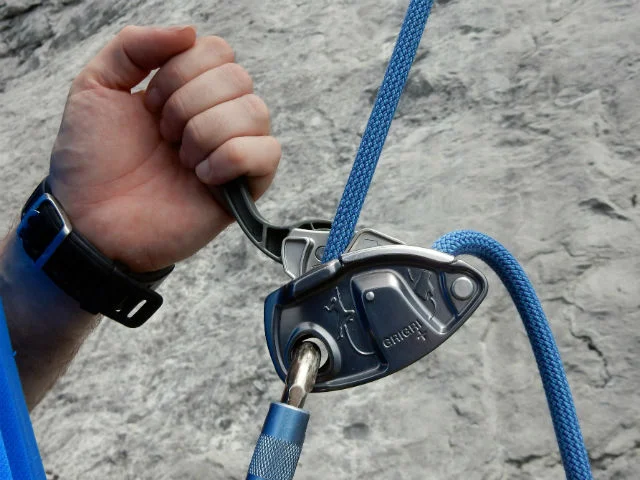
This is probably the most important piece of equipment and also the one with the greatest variety. For a long time, the most common belaying method was a carabiner and a munter hitch. In recent decades, many different belay devices have appeared on the market. Some have come and gone, while others have stood the test of time. Choosing a belay device depends on your plans and, naturally, your preferences. If you plan to climb multi-pitch routes using double or twin ropes, different factors apply than for single-rope climbing.
A good starting point is to distinguish between manual-assisted and auto-locking belay devices. Auto-locking devices lock the rope automatically when the climber falls, while manual devices require active input from the belayer. The most well-known auto-locking device is the GriGri (by Petzl), although there are other models offering similar results with different or similar technical solutions. Be sure to read the manual, practice using the device with an experienced climber, and always remain attentive when belaying—even when using an auto-locking device. Before climbing, always check both your own and your partner’s belay setup.
Ropes
All climbing disciplines except bouldering (and free soloing) require a rope for protection. There are three main types of ropes: single ropes, half (double) ropes, and twin ropes. As a general rule (with exceptions), single ropes are used for single-pitch routes, while half or twin ropes are used for multi-pitch climbing, as they offer additional safety and allow full-length rappels.
Your first rope will most likely be a single rope. There are many manufacturers offering ropes in different lengths. As a beginner, we recommend buying a robust rope that is not overly elastic, as you will mainly use it for top-roping and working routes. “Robust” generally means a larger diameter (e.g., over 10 mm) compared to high-end ropes with diameters below 9 mm. Regarding length, make sure the rope allows you to climb the routes in your area safely. For example, if the longest route in your area is 35 meters, your rope should be at least 70 meters long.
Another factor to consider is rope treatment, which helps prevent dirt and moisture absorption and improves handling. Many ropes include terms such as “dry” or “superdry” in their name to indicate the type of treatment.
Helmets
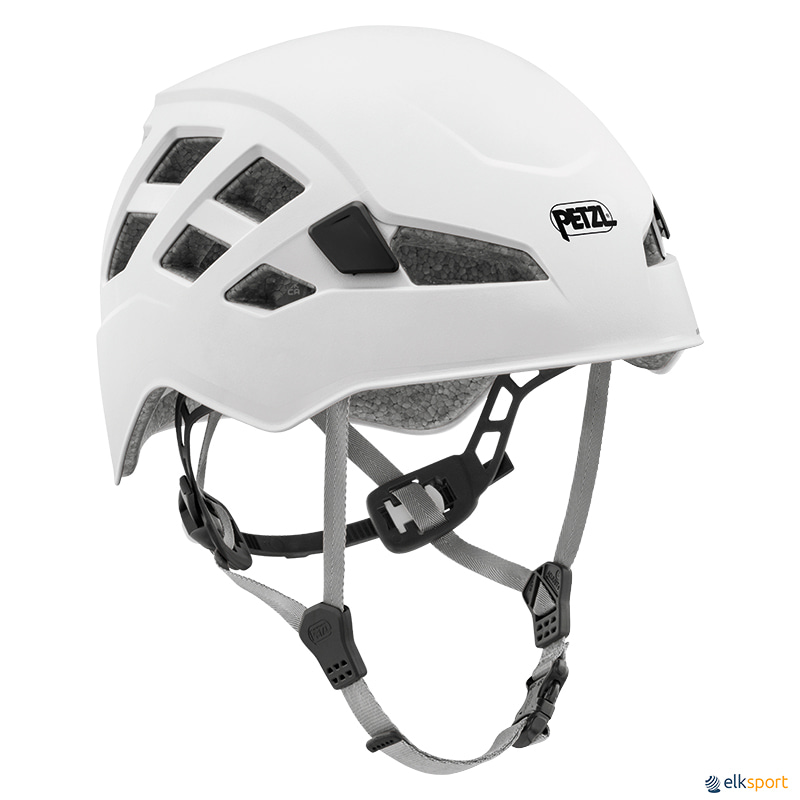
If you plan to climb outdoors, you should consider buying a climbing helmet to protect yourself from falling rocks or gear, or from head injuries caused by hitting the rock during a fall. Hopefully, you will never need it, but depending on rock quality and whether you venture onto multi-pitch routes, we strongly recommend wearing one both while climbing and belaying.
Quickdraws
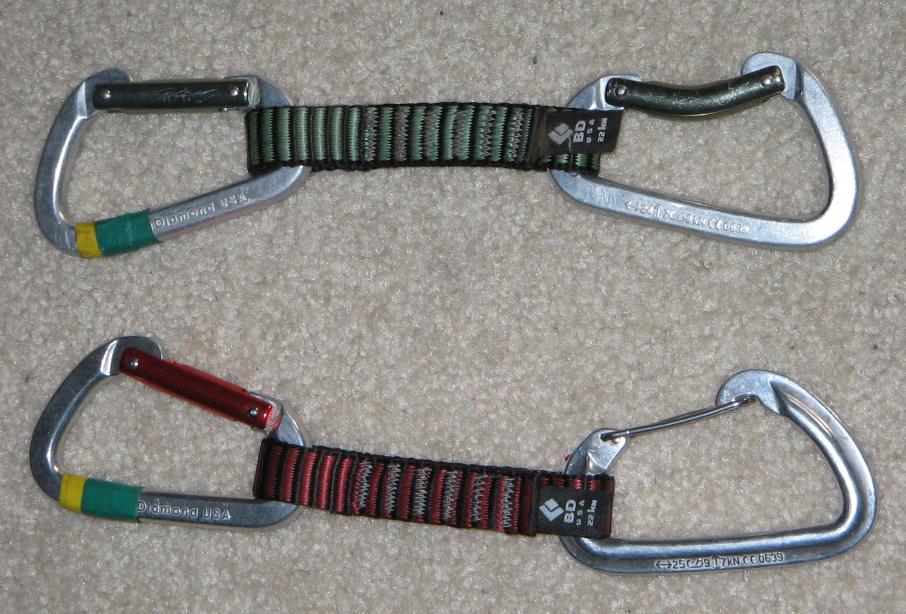
Quickdraws (also called “draws”) consist of two carabiners connected by a textile sling and are used to clip the rope into pre-installed protection such as bolts. They are mainly used in sport climbing. Often, the textile sling includes a small rubber keeper that holds one carabiner in place to make clipping the rope easier, while the other carabiner (clipped to the bolt) can move freely. Quickdraws come in different shapes, sizes, colors, and sling lengths to meet different needs while climbing. As a beginner, a basic set of quickdraws (typically between 10 and 15, depending on route height and local requirements) is sufficient, and you can expand your collection as you progress.
Crash pads
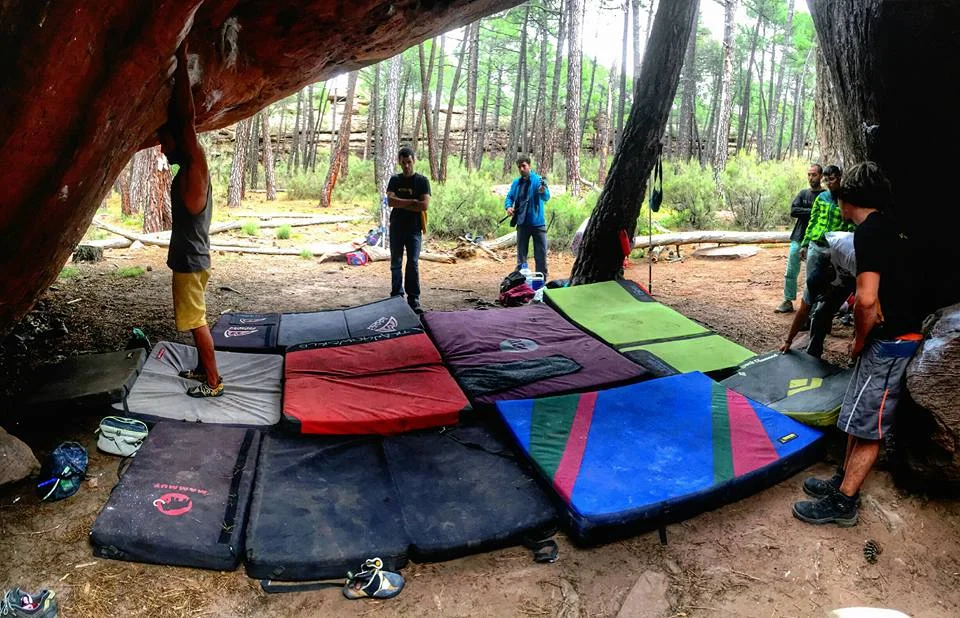
When bouldering outdoors, you will need one or more crash pads (often equipped with straps for carrying them like a backpack) to make landings safer. Crash pads come in different sizes and thicknesses. It is best to have several pads to cover gaps and stack them to create a flat, continuous landing surface. Before going on a bouldering trip, meet with your friends and check whether you have a sufficient set of crash pads.
Required Skills
Now that you are familiar with the main climbing disciplines and equipment, you may be wondering what physical requirements and skills you need or need to develop. Let’s start with practical skills.
Practical Skills
A key skill for rock climbing is knowing how to tie certain knots (obviously unnecessary in bouldering). Entire books and well-designed apps exist that teach dozens of useful knots. Here we mention only three of the most important ones, which you should be able to tie with your eyes closed. The figure-eight knot is used to tie in or join two ropes; the prusik knot is used as a backup when rappelling or for ascending a rope; and the munter hitch can be used for belaying if, for example, you forgot your belay device at home. Practice them at home and learn to recognize them. Before climbing, always check your own knot and your partner’s (mutual check).
Physical Skills
This may surprise you, but you do not need exceptional physical abilities to start climbing. While climbing is obviously a physical activity, the wide variety of disciplines and difficulty levels means that anyone can enjoy it. Soon after starting, you will notice how quickly you progress and how enjoyable it is to experience this improvement. Your technique will improve, and you will gain physical strength (especially in your arms and upper body). Flexibility is helpful but not essential when starting out.
Climbing is also accessible to people with disabilities—there are even paraclimbing competitions. Height, weight, strength: none of these matter. Simply climb and enjoy this incredible sport.